
Does Aluminum Rust?
Answer: No, aluminum does not rust but it does corrode over time.
Throughout this article, we will have a closer look at the question: Does aluminum rust? And we will cover the differences between rust and corrosion. An in-depth look will also be given at how this may affect your aluminum packaging.
What is Aluminum and Can it Rust?
Aluminum is a chemical element which carries the symbol AI and atomic number 13. This silver metallic substance is solid at room temperature. Due to its lower density compared to other metals, it is very light in weight. This makes its appliance common throughout many different industries. Aluminum is a soft non-magnetic metal that is known for its numerous benefits. It is light in weight yet extremely durable and easy to work with. On top of that, it is affordable compared to other metals and it’s considered to be one of the most environmentally friendly metals on earth. Although aluminum offers a great deal of benefits, people who work with it or are considering using it have to ask themselves, does aluminum rust like other metals such as steel and iron? This is a valid concern, considering that rust can weaken and destroy a metal over time.
Luckily it is easy to answer the question ‘Does aluminum rust?’ as the answer is a simply and straightforward No – Aluminum does not rust because it does not contain iron. It is, however, extremely important to understand that, although aluminum does not rust, it is a highly reactive metal. When pure and uncoated aluminum is exposed to water, air, or soil, the metal reacts with the oxygen. As a result, a thin layer, or coating, of aluminum oxide is formed that will bond itself to the surface of the metal. This coat can be recognized by its powdery white or dull grey finish. This oxide coating will harden and stay attached to the aluminum as, unlike rust, it does not flake or fall off. The aluminum oxide formed actually has a protective feature as it protects the metal from corroding. Pure aluminum is free from corrosion as long as this layer of aluminum oxide remains intact.
Aluminum Corrosion
Aluminum does not rust, but it does corrode. As mentioned above, pure aluminum has a natural defence mechanism against corrosion, which is the forming of an aluminum oxide coating when it’s exposed to air, water, or soil. This coating is highly resistant and it even renews itself when it’s damaged, which protects the aluminum from corroding. There are, however, some factors that can play a role in making this coating become unstable. When this happens, the metal is exposed to the elements and, over time, will corrode.
There are different types of corrosion but the most common type found on aluminum is galvanic corrosion. This occurs when aluminum comes in contact with other metals. When this happens, an electrical circuit is formed between the two metals in question. As a result of this galvanisation process, one metal becomes stronger whereas the other becomes weaker. Because aluminum is a metal with a highly reactive nature, aluminum will, unfortunately, always end up the weaker metal in this galvanization process. As a result, corrosion occurs.
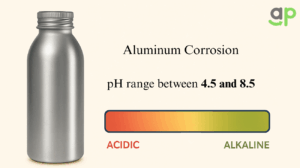
Besides galvanic corrosion, aluminum corrosion can also happen when the metal is exposed to extreme pH levels. Substances with a pH level lower than 4.5 and higher than 8.5 are known to break down the aluminum oxide coating at a much faster speed than that it can repair itself. Therefore, to avoid aluminum corrosion, it is important to only expose the metal to environments with a pH range between 4.5 and 8.5.
So, although aluminum is a highly attractive metal that brings along an abundance of user benefits for manufacturers, consumers, and the environment – corrosion is an important factor that has to be kept in mind. Luckily, it mainly is pure and uncoated aluminum that is prone to the above mentioned types of aluminum corrosion. As a result, many industries, such as the packaging industry, apply a special coating to the aluminum. This coating protects the aluminum from oxidation and corrosion.
Aluminum In The Packaging Industry
Due to its many benefits, aluminum is a popular metal used in the packaging industry. Aluminum is used for making tins, bottles, squeeze tubes, disposable food containers, and a whole lot more. This is no surprise, keeping in mind that aluminum is food-safe by nature, lightweight, affordable, easy to work with, and fully recyclable. As a result, this environmentally friendly metal has become a packaging material favorite among both manufacturers and consumers alike.
But how does the above mentioned risk of aluminum corrosion affects its use in the packaging industry? After all, many products stored inside aluminum packaging are liquid or moist, such as lotions, cremes, sprays, and other types of food products, beverages, or cosmetics. Although this is a valid concern, you luckily have nothing to worry about.
In the packaging industry it is uncommon to use raw and uncoated aluminum exactly for this reason. Raw and uncoated aluminum corrodes. This is why, in the packaging industry, a strong food-grade and BPA-free coating applied over the aluminum sheet. This coating does not only protect the aluminum container from corrosion, but also prevents the product stored inside to come into direct contact with the metal. This brings along added safety features and furthermore increases the durability and shelf life of the packaging. As long as your aluminum packaging has been coated, then there is no reason to worry about corrosion in any way or form.
You may also like